
3 Pillars of Product Success you Cannot Ignore
July 17, 2024


Every day, we witness the shifting fortunes of startups: one breaking free from obscurity to capture the imagination of millions, another struggling to make headway despite a stellar team, and yet others tumbling from "Unicorn to Unicorpse." While there's no foolproof recipe for startup success, certain traits frequently emerge among those that achieve a breakthrough. My focus here is on product , highlighting not rules, but characteristics common to the most successful products.
We focus on three of the most significant ones.
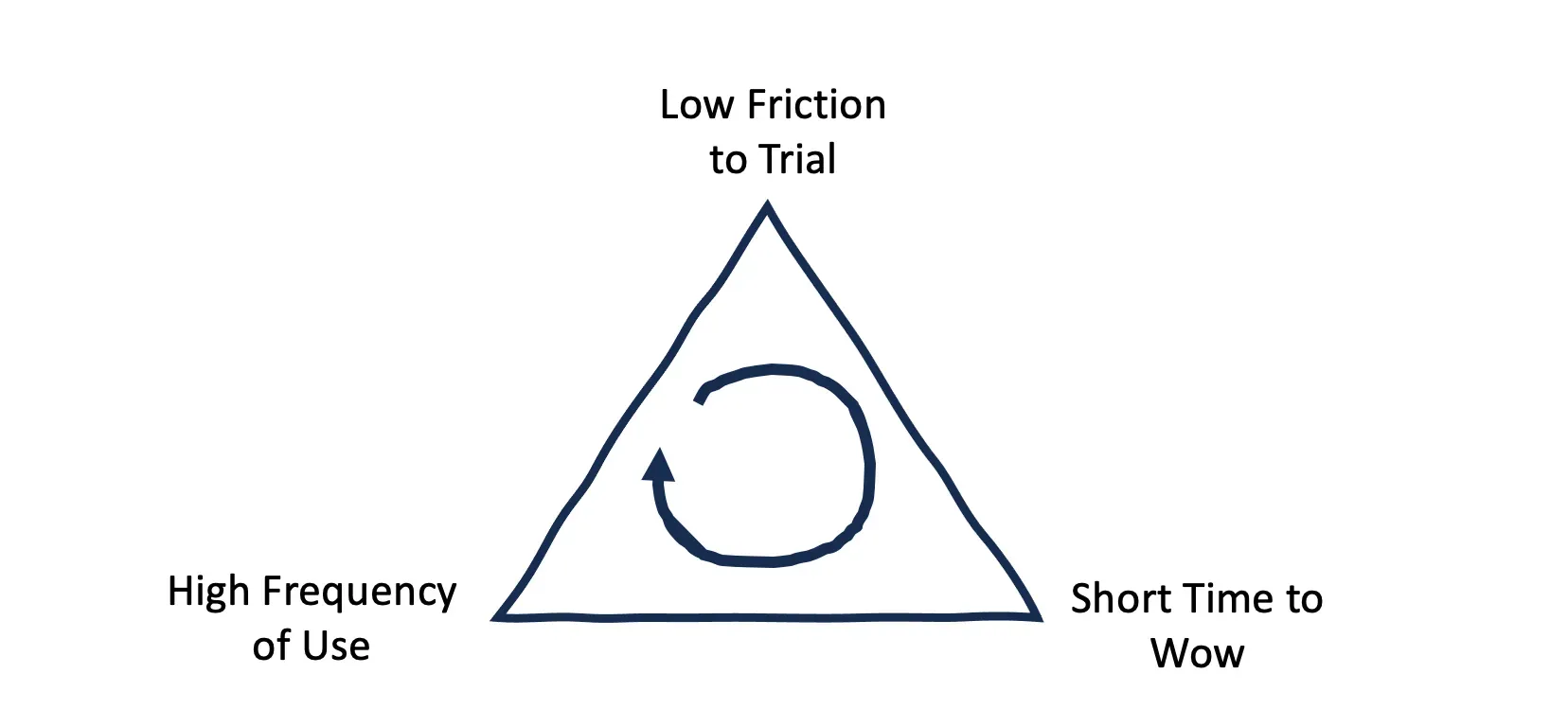

THREE PILLARS OF PRODUCT SUCCESS
1. Low Friction to Trial:
Getting your product, or a minimum viable product, into users' hands—whether consumers or enterprise targets—is the first challenge. Entrepreneurs leverage personal connections, marketing, and outbound calls for initial deployment.
Yet, for users to engage, deploying the product in their environment must be effortless. This ease of deployment, or lack thereof, constitutes the friction to trial.
For consumer products, simplicity is key—think one-click installations that allow immediate product experience. The same principle applies to B2B products, which must integrate seamlessly into existing enterprise environments with minimal disruption. Products that fit neatly into user-preferred environments, like chrome, slack, or Shopify plugins, inherently face lower friction to trial.
High friction leads to protracted customer feedback cycles, delaying product refinement. Early versions seldom hit the mark; rapid, genuine feedback is essential for refinement and adoption. This holds true for hardware too. New chips which are “chip compatible” or drop-in replacement for existing hardware configurations, can significantly ease trial and adoption by offering direct replacements for existing solutions.
2. Short Time to Wow:
So you have optimized your product to reduce friction to trial and installing and use is smooth as silk. What next?
Time to wow refers to the time required, after the user installs and begins using the product, where they experience the “10x” benefit as compared to their existing solution.
The user is trusting the new product with their investment of time - the faster they are able to get a return on this investment, the more likely it is that they’d use the product. Bringing the key value proposition to the front of the beginner user flow, is thus an important consideration. If the key benefit is buried deeper into the product usage, it is likely the user would get tired and ‘churn out’ before ever experiencing that benefit. This is no different than a users bouncing off a web-page where the content doesn’t catch their attention on the landing page.
SaaS products with limited time free-trial business models need to pay particular attention to this. Users needs to experience the advertised value prop well within the trial period to have sufficient incentive to upgrade to a paid plan.
Freemium business models have a bit more leeway as users tend to use the free product for a longer duration but even these models suffer from high churn if the value prop is buried inside the product.
Whereas a low friction to trial helps keep CAC in check, a short Time to Wow, helps reduce churn.
This requires careful user experience design to float the key value proposition up in such a way that the most users experience it in their natural course of use early in the cycle.
3. High Frequency of Use:
Once the user has installed and experienced the wow moment, it is likely they will remember the product.
However, if the user need for the product is infrequent, they are equally likely to forget about the product in due course. This results in a costly acquisition flow, as the user has to be effectively re-acquired even though they might have previously used the product.
We see this in infrequent use e-commerce verticals. Imagine a site that sells furniture or automobiles. The time between repeat use is very high and leads to a natural customer churn. Such products, need to effectively re-acquire the customer the next time they have the same need.
Some B2B tools have high engagement during use, but used sporadically. Business survey and feedback tools for instance might have a long gaps between use. The marketing manager in this case, may use one set of tools the first time, and re-explore the tools the next time they have a need (unless they survey on a regular basis). Same goes for recruiting and hiring platforms that are heavily used during cycles of quick head count addition and fall into disuse in other times. E-learning, employee training tools, vulnerability assessment services also have a periodic need state rather than being a part of the daily workflow.
In such cases, the customer is likely to begin the procurement process all over again, compare features and price-points, and then make their purchase decisions.
On the other hand, products with high frequency of use benefit with high stickiness and a high life time value. Their users get accustomed to the specific product experience and over a period of time customize the product to their needs. CRMs (hubspot, salesforce), Collaboration (Slack, Email, Google docs), Project management (Asana), Payroll management software and many others have high frequency daily or weekly use cases.
Such products end up having a strong word of mouth, leading to high organic growth. The holy grail of all product design.
Summary:
Success in product development doesn't follow a preset formula. Timing, market dynamics, and industry trends all play roles. However, focusing on low friction to trial, ensuring a short time to wow, and fostering high frequency of use can significantly bolster a product's chances of quick adoption, sustained use, and eventual viral success.
Among startups founded in the last 5 years (after 2019), which of them in your opinion have these product characteristics?
Shripati Acharya is co-founder & Managing Partner at Prime Venture Partners, an early stage VC firm based out of Bangalore, India. He tweets as @shripati. Prime invests in category creating, early stage companies founded by rock star teams
Share:
Related Blogs

Why we invested in Klaar

Why We Invested in Illumine